1. Introduction
In industrial fluid handling systems, the correct selection and installation of fittings is crucial. Any leakage, vibration, or pressure drop in the pipeline can impair the performance of the entire system. Flanged fittings play a fundamental role in the installation and operation of pumps due to their high mechanical strength, ease of disassembly, and resistance to pressure and temperature.
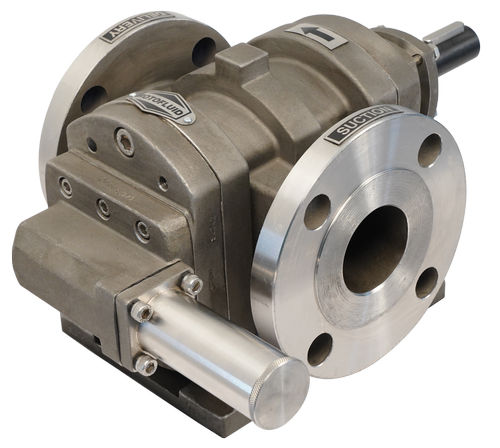
Gear pumps are among the most common positive displacement pumps and are typically used to pump viscous fluids such as oils, greases, polymers, and even some fuels. This article examines the design and importance of flanged fittings in gear pumps with regard to design, selection, standardization, and maintenance.
2. Gear pumps and their applications: Introduction
Gear pumps consist of two rotating, meshing gears and are used to transport a defined volume of fluid from an inlet to an outlet. These pumps are generally divided into two types:
-
External gear pump
-
Internal gear pump
The most important features of gear pumps are:
-
Ability to pump highly viscous liquids
-
Smooth and even flow
-
The design is simple and compact.
-
Quiet interior
-
If installed correctly, maintenance is minimal.
The type of inlet and outlet connection is of great importance for the supply lines of these pumps, as the operating pressure, temperature, type of fluid and the material of the pump housing determine the appropriate connection type.
3. The importance of connections in pump systems
In every pumping system, the connection between the pump and the pipeline must meet the following conditions:
-
Fluid loss has decreased.
-
To facilitate disassembly and maintenance
-
Reduces mechanical stress caused by vibrations and operating temperature.
-
Occupational health and safety regulations must be observed.
Flange fittings are designed to meet these requirements. Threaded or weld fittings are suitable for low-pressure and light-duty lines, while flange fittings are ideal for medium- and high-pressure lines as well as for industrial pumps.
4. Definition and structure of labial connections
A flange is a plate- or ring-shaped component used to connect pipes, pumps, valves, and other plant components. Flanges are typically made of carbon steel, stainless steel, cast iron, nickel alloys, or bronze.
The main components of the lip joint are:
-
Two flanges (one at the pump outlet, the other on the pipe) .
-
Seals or sealing connections
-
A set of screws and nuts
After the fluid has passed through the pump, it is connected to the pipe via an outlet flange. This connection must be pressure-, high-temperature-, and corrosion-resistant to prevent leaks.
5. Flange types for gear pumps
Different flange types are used depending on the system design, operating pressure, and pump size. The most common flange types are:
| lip | Special feature | Application areas of gear pumps |
|---|---|---|
| Welded neck | It has a conical neck and high resistance to high pressure. | High-voltage and high-vibration systems |
| slippery lip | Easy to assemble and weldable from both the inside and outside. | moderate pressure |
| socket welding flange | Secure and precise connection | Small diameter wire |
| Threaded lip | No welding required | Quick installation, low pressure |
| Empty board | End line blocker | Check or turn off the power. |
| Lip overlap | Adjustable and easy to transport | In highly corrosive systems |
Gear pumps typically have operating pressures in the range of 10 to 25 bar and usually use welded or machined neck flanges.
6. General rules for lip design
Several international standards exist for the design and manufacture of flanges . The most important include:
-
ASME B16.5 – Applies to steel flanges with pressure values up to a maximum of 2500 psi.
-
EN 1092-1 – European standard for steel flanges
-
DIN 2633/2634 – German standard
-
API 605/6A – Developed for the oil and gas industry
-
ISO 7005 – Integrated International Standard
In Iran, gear pump flanges are typically designed and selected according to ASME and DIN standards . Choosing the wrong flange class (150, 300, 600, etc.) can lead to leaks or failures under high pressure.
7. Select the appropriate flange for the gear pump.
The following factors should be taken into account when selecting the appropriate flange for a gear pump:
-
Nominal pressure:
Must correspond to the maximum delivery pressure of the pump. For example, a nominal pressure of 300 bar is suitable for a pump with a nominal pressure of 20 bar. -
Liquid temperature:
For high-temperature liquids (e.g., heat transfer oil), the edges should be made of heat-resistant alloys. -
Type of liquid:
For corrosive liquids (acids and alkalis), stainless steel or coated edges are required. -
Pipe connection method:
Depending on the installation and maintenance conditions, welded or threaded flanges are used. -
Nominal diameter:
It should match the inlet and outlet diameter of the pump to ensure a uniform flow.
8. Sealing elements in boot joints
The secret to a proper sleeve connection lies in ensuring a reliable seal between the two sleeve surfaces
. Gaskets are used for this purpose. Common gasket types include:
-
Non-metallic seals: made of rubber, Teflon or graphite, suitable for low-pressure environments.
-
Screw seals: suitable for high-pressure and high-temperature environments (widely used in industrial pumps).
-
Metal seals: are used in special systems and environments with extremely high pressure.
Spiral-wound graphite seals are most commonly used in gear pumps for oil transfer because they can withstand temperatures up to 500 degrees Celsius.
9. Method for assembling flange connections on gear pumps
Correct flange mounting is crucial for the pump’s service life and the prevention of leaks.
The standard mounting procedures are as follows:
-
Before tightening the screws, ensure that the flange and pipe are aligned exactly (misalignment can lead to leaks and additional stress).
-
Choose the appropriate seal depending on the liquid and temperature.
-
Tighten the screws symmetrically with a uniform tightening torque (crosswise).
-
To distribute the tension, use a flat washer and a spring under the nut.
-
Washers must not be reused when opening and closing the edges .
-
After installation, a visual inspection and a water pressure test must be carried out .
10. Tips for maintenance and inspection
Over time, flange connections can leak or corrode. Regular inspections should include the following:
-
Regular visual inspections should be carried out to ensure that there are no oil leaks.
-
The tightening torque of the screws should be checked after a few hours of operation .
-
Check the edge surface for corrosion. If the contact surfaces are rusted or damaged, the edge must be replaced.
-
The seal must be replaced every time the system is used .
-
In humid or corrosive environments, corrosion protection coatings should be used .
11. Comparison of flange connections with other connection methods
| Connection type | To use | Shortage | Application areas of gear pumps |
|---|---|---|---|
| lip | Removable, high-pressure resistant and safe to install. | Higher costs and more space | Very often |
| thread | Quick installation, no welding required. | High-pressure leak | Low pressure |
| welding | High strength, leakage resistance | That’s difficult to fix. | Permanent system |
| Clip | Quick On/Off | Temperature and pressure limits | food industry |
12. Precautions
The following precautions must be observed when assembling or disassembling flange connections:
-
Never open the edge under pressure.
-
Use the appropriate torque wrench.
-
Before installation, it must be ensured that the sealing surface is absolutely clean and dry.
-
The entire system must be cooled using heat pipes.
13. Industrial applications of flanged gear pumps
Flange connections are found on gear pumps primarily in the following industries:
-
Oil, gas and petrochemical industry (transport of oil, asphalt and fuel)
-
Transport of vegetable oils, syrups and concentrates for the food and pharmaceutical industries.
-
Steelworks and lubricants
-
Industrial hydraulic and lubrication systems
In these sectors, the use of flanges not only facilitates routine maintenance but also improves the safety and reliability of the system.
14. Conclusion
In heavy industry, flanged connections for gear pumps are the preferred choice due to their high strength, ease of handling, high pressure resistance, and reliable insulation. The correct selection of the flange connection type, gasket, and mounting method significantly influences pump efficiency and service life. Compliance with standards such as ASME B16.5 and the use of high-quality materials effectively prevent problems such as leakage, vibration, and premature failure.
In short, it can be said that in the design and operation of any industrial gear pump, the flange connection is not just a mechanical component, but a key element that ensures the safety and stability of the entire system.